In this class, I have learned a lot about research and how to apply it to art and art education. I feel like there’s still a lot to learn! For my pilot study, I called libraries in St-Johns County and researched the types of art programs they offer. I felt like I had included everything, but I guess not enough details (APA formatting of charts and tables…) Even though we think we understand, there’s still more to be learn. Maybe this class needs to be longer after all.
I learned to focus on one subject and not to be all inclusive in a research. That a research needs to be meaningful and reach other’s interests as well as my own. This class helped me defend my opinions and justify my research path. I also learn to find my own resources to comprehend a lesson’s topic and which might have helped some of my classmates as well; Patricia wrote on my week 3 discussion post about qualitative research: “You've done a nice job on breaking down the research types and making them understandable to me”.
I think this class helped me see ways in which I can research more about libraries and art; not only in the kinds of programs offered in libraries, but also how can the visual art help research in libraries. This week’s readings reminded me of Richardson’s article Poetics, Dramatics, and Transgressive Validity: The Case of the Skipped Line; visual arts, like literary arts can be used to express results of a research as well as be a tool for researchers during their research.
There are so many aspects of art and education that I’m interested in researching; I feel like it’s only the beginning.
Richardson, L. (1993). Poetics, dramatics, and transgressive validity: The case of the skipped line. Sociological Quarterly, 34(4), 695-710.
Showing posts with label Marie. Show all posts
Showing posts with label Marie. Show all posts
Monday, December 5, 2011

Tuesday, November 29, 2011
What impressed me the most.
My research has taken me through many interesting reading about community-based art education and libraries. Even though I work in a library and have frequented libraries my whole life, I didn’t know much about libraries’ history. I read a great article about the future of libraries by Frey. This articles makes us reflect about the future of printed books and consequently the future of libraries. If printed books are phasing out, will library be reduced too online only? Libraries are moving more and more towards online databases, buying less books, CDs, DVDs… Frey suggests that libraries move towards a cultural center for the community (which has been like that in some countries). It takes into perspective something that we often forget and it’s how much our world is changing. It’s happening so fast, we hardly get a chance to adapt. As our world change, so are the institutions surrounding us and their purpose in our society. Libraries are mainly a source of information; librarians are now called information specialists, since their main role is to find information for patrons (or customers) not just finding books.
Another resource I found interesting was a book called Histories of Community-Based Art Education by Congdon & Boughton. This book is a collection of chapters written by many scholars talking about different aspect of community-based art education and how they came about. It was a view on community-based art education I had never seen or read about before. One chapter in particular attracted my attention with a connection with library “crafts” program: Kit crafts and the people who make them: A history of pre-packaged pedagogy since 1930 by Agostinone-Wilson. The author recalls how “craft” has changed over the years with pre-made kits allowing anybody to be able to make something (paint by numbers, scrapbooking, model cars…). She also mentions how before pre-packaged kits came about, an artist or crafter had to make mix their glue, paints and were more involve with the process. If we think of a quilter who used to create their own patterns and stitch by hand (or machine), as now you can buy a machine that quilts for you by following a pattern you buy; or embroiders filigree initials in fabric. Should we consider them crafters? Did the term “craft” changed over the years and doesn’t represent what it used to?
As for the articles we read over the semester two really resonated with me and left me thinking and wondering. One was about qualitative research results presented as poetry and drama play: Poetics, dramatics, and transgressive validity: The case of the skipped line by Richardson. The other was The potency of humor and instructional self-efficacy on art teacher stress by Evans Palmer. Both articles enlighten me in ways research can take place and how we can display our results. I might not use these methods for this particular research, but it opens up a variety of creative options. Art educators being creative people, I wonder how come we haven’t had more creative outcomes from researches.
Congdon, K. G., & Boughton, D. (Eds.). (1998). Advances in program
evaluation: Vol. 4. Evaluating art education programs in community centers: international perspectives on problems. Greenwich, Conn: JAI.
Evans-Palmer, T. (2010). The potency of humor and instructional self-efficacy on
art teacher stress. Studies in Art Education, 52(1), 69-83.
Frey, T. & Sloan, T.(2010). Newsmaker: The future of libraries: Interview with
Thomas Frey. American Libraries, 41(8), 21.
Richardson, L. (1993). Poetics, dramatics, and transgressive validity: The case of
the skipped line. Sociological Quarterly, 34(4), 695-710.
Another resource I found interesting was a book called Histories of Community-Based Art Education by Congdon & Boughton. This book is a collection of chapters written by many scholars talking about different aspect of community-based art education and how they came about. It was a view on community-based art education I had never seen or read about before. One chapter in particular attracted my attention with a connection with library “crafts” program: Kit crafts and the people who make them: A history of pre-packaged pedagogy since 1930 by Agostinone-Wilson. The author recalls how “craft” has changed over the years with pre-made kits allowing anybody to be able to make something (paint by numbers, scrapbooking, model cars…). She also mentions how before pre-packaged kits came about, an artist or crafter had to make mix their glue, paints and were more involve with the process. If we think of a quilter who used to create their own patterns and stitch by hand (or machine), as now you can buy a machine that quilts for you by following a pattern you buy; or embroiders filigree initials in fabric. Should we consider them crafters? Did the term “craft” changed over the years and doesn’t represent what it used to?
As for the articles we read over the semester two really resonated with me and left me thinking and wondering. One was about qualitative research results presented as poetry and drama play: Poetics, dramatics, and transgressive validity: The case of the skipped line by Richardson. The other was The potency of humor and instructional self-efficacy on art teacher stress by Evans Palmer. Both articles enlighten me in ways research can take place and how we can display our results. I might not use these methods for this particular research, but it opens up a variety of creative options. Art educators being creative people, I wonder how come we haven’t had more creative outcomes from researches.
Congdon, K. G., & Boughton, D. (Eds.). (1998). Advances in program
evaluation: Vol. 4. Evaluating art education programs in community centers: international perspectives on problems. Greenwich, Conn: JAI.
Evans-Palmer, T. (2010). The potency of humor and instructional self-efficacy on
art teacher stress. Studies in Art Education, 52(1), 69-83.
Frey, T. & Sloan, T.(2010). Newsmaker: The future of libraries: Interview with
Thomas Frey. American Libraries, 41(8), 21.
Richardson, L. (1993). Poetics, dramatics, and transgressive validity: The case of
the skipped line. Sociological Quarterly, 34(4), 695-710.
Sunday, November 20, 2011
Art in libraries... week 5
There has been any research in art programs in library settings. There are articles written about what some libraries do, what they offer, but there’s no concrete information on the type of programs offered, what are their impact on the community? Who attends these art programs? (…)
In the art education field, there are some studies and written work done on community-based art education, but nothing specifically on libraries. Libraries are cultural centers; offering a multitude of resources free of charge to the community. How can they have been overlooked for so long? Maybe it is because they usually don’t have specialists (art educators) on staff, teaching the art classes? However many libraries have developed partnerships with museums and art educators who come in and offer art classes to their patrons.
Questions yet to be answered:
- What type of library programs are offered in Florida Libraries?
For my research, I will have to combine qualitative and quantitative research methods. Most of my questions evolve from a quantitative approach. But, it doesn’t stop there. The impact those art programs have is important too. I will conduct interviews and be on site to observe some of the programs.
Monday, November 14, 2011
Data Gathering Methods
I have an idea on how I will gather the data I need for my research. It is mainly going to be through interviews, site visits and program observation.
Interviews
Interviews
- I will design open-ended questions
- I will use a voice recorder (app on my phone, very cool! It emails me the recording once done)
- Try to do as much as the interviews in person. If not, I will do it over the phone or by emails.
Site Visits / Program Observation
- I will visit the libraries offering art programs. Will focus on the libraries with interesting art programs.
- I collect my observation by taking notes as well as by video-recording (if ok with library staff).
I found an interesting online document created by Kris Zimmermann, Janise Hurtig, and Erin Small for the Center for Research on Women and Gender, University of Illinois at Chicago I'm sharing the link, it might help others. It's a goes over the different methods to gather data (for an evaluation project). Was very useful to me.
http://www.uic.edu/depts/crwg/cwitguide/04_EvalGuide_STAGE2.pdf
Little Boy poem by Helen Buckley
This week's reading reminded me of a poem I read about creativity. It's written in a similar way as the poetic rendering of a sociological reseach by Lauren Richardson. Even though this "Little Boy" poem is not the result of a research, I can see art teachers using this method.
Here's a link to a video someone made from the poem. I think it's neat!
Little Boy by Helen Buckley
http://www.youtube.com/watch?v=VV929vcGS70
School Arts Magazine sent me a scan (PDF) of the poem that appeared in their 1961, October issue. I can email it to anyone who's interested.
Here's a link to a video someone made from the poem. I think it's neat!
Little Boy by Helen Buckley
http://www.youtube.com/watch?v=VV929vcGS70
School Arts Magazine sent me a scan (PDF) of the poem that appeared in their 1961, October issue. I can email it to anyone who's interested.
Monday, November 7, 2011
Art in Libraries
Well, my research is going to focus on art programs offered in library settings. There's not much written on the subject. So most of my references will be geared towards community-based art education as well as library service articles.
Here's a video I found about what the San Diego Library does as an after school program.
http://www.youtube.com/watch?v=jn0Rdg7nKG0
Also, I found one article about two artists who used to volunteer in an elementary school and teach art classes, but the school decided to spend that time getting ready for testing. They turned to the public library to fill the gap. http://www.signaltribunenewspaper.com/archives/3498
This last article is of the Museum of Florida Art who offer art classes in conjunction with their exhibit through libraries in Volusia County (near Daytona). http://daytonasun.com/Articles/Community/Local-Museum-Offers-Children-s-Art-Program-At-Libraries.html
These arethe kinds of things I want to see and discover and research about. Who are giving the classes? What are their art background? How is the participation?
Here's a video I found about what the San Diego Library does as an after school program.
http://www.youtube.com/watch?v=jn0Rdg7nKG0
Also, I found one article about two artists who used to volunteer in an elementary school and teach art classes, but the school decided to spend that time getting ready for testing. They turned to the public library to fill the gap. http://www.signaltribunenewspaper.com/archives/3498
This last article is of the Museum of Florida Art who offer art classes in conjunction with their exhibit through libraries in Volusia County (near Daytona). http://daytonasun.com/Articles/Community/Local-Museum-Offers-Children-s-Art-Program-At-Libraries.html
These arethe kinds of things I want to see and discover and research about. Who are giving the classes? What are their art background? How is the participation?
Define Qualitative Research
Since English is not my first language, I often have to research extra for vocabulary that I don't use or hear often. When I saw the word "Qualitative" I thought of "quality", but as I was reading the texts, I figured out it was a littl more then just that simple meaning.
I came across this on wikipedia (I know, it's not a reliable source, but still helpful) and really helped me put understand, since it broke it down for me in an easy way.
http://en.wikipedia.org/wiki/Qualitative_research
I hope this can help someone else as well.
I came across this on wikipedia (I know, it's not a reliable source, but still helpful) and really helped me put understand, since it broke it down for me in an easy way.
http://en.wikipedia.org/wiki/Qualitative_research
I hope this can help someone else as well.
Art in Libraries

Finally made a decision... I'm going to research art programs available in libraries throughout Florida. I will then focus on the libraries that offer meaningful programs; their attendance, who does it target, instructor's training...
I'm attaching my research map.
Sunday, November 6, 2011
Research maps
I know I'm late with this and I haven't picked one yet... here are 2 prelinary research "maps" for ideas I'd like to explore. If you guys can give me feedback and your opinion on which way I should go, PLEASE do!
Art programs in Libraries Research Map
Purpose Statement: To describe and evaluate the art classes available in libraries in Florida.
Research Questions:
-What kind of art programs are offered in libraries?
-Who is the targeted audience?
- What background, training, or formation is provided to the art program facilitators?
Data Collecting: interviews
Analysis Method: Content analysis
Trustworthiness and Validation: TBD
Main Knowledge Producer: participants
Role of Research: interpret
Research Relation to Practice: describe the practice of art education in libraries.
Freinet Pedagogy and Art Education Research Map
Purpose Statement: To understand and create connections between Freinet Pedagody and art education
Research Questions: How can Freinet’s tenets be applicable to art education today?
Sampling Strategies: tbd
Data Collecting: Archival material (pamphlets and books), interviews with school teachers using his methods.
Analysis Method: Historical analysis
Trustworthiness and Validation: Scholars who studied Freinet: Acker 2007, Legrand 1993
Main Knowledge Producer: participants (Freinenet and ecole modern schools) and researcher (making connections with art education classroom)
Role of Researcher: Active, Advocate
Research Relation to Practice: change and transform practice by bringing new knowledge to the art education world.
Thanks for any kind of feedback!
Art programs in Libraries Research Map
Purpose Statement: To describe and evaluate the art classes available in libraries in Florida.
Research Questions:
-What kind of art programs are offered in libraries?
-Who is the targeted audience?
- What background, training, or formation is provided to the art program facilitators?
Data Collecting: interviews
Analysis Method: Content analysis
Trustworthiness and Validation: TBD
Main Knowledge Producer: participants
Role of Research: interpret
Research Relation to Practice: describe the practice of art education in libraries.
Freinet Pedagogy and Art Education Research Map
Purpose Statement: To understand and create connections between Freinet Pedagody and art education
Research Questions: How can Freinet’s tenets be applicable to art education today?
Sampling Strategies: tbd
Data Collecting: Archival material (pamphlets and books), interviews with school teachers using his methods.
Analysis Method: Historical analysis
Trustworthiness and Validation: Scholars who studied Freinet: Acker 2007, Legrand 1993
Main Knowledge Producer: participants (Freinenet and ecole modern schools) and researcher (making connections with art education classroom)
Role of Researcher: Active, Advocate
Research Relation to Practice: change and transform practice by bringing new knowledge to the art education world.
Thanks for any kind of feedback!
Thursday, October 27, 2011
Welcome to ARE 6746 Blog
Hello, ARE 6746 students.
We moved the blog outside of Sakai based on your feedback. Remember that the main information about your blog post assignments (you can read it here) still apply. The purpose of this post is to highlight some features about this new blog.
 which will generate a window that looks like this
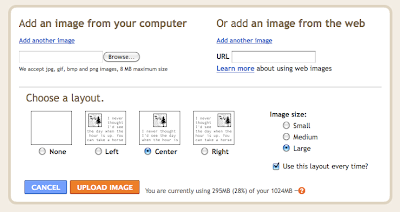 If the image you would like to add is on your computer, choose "browse" and find the image on your computer. Then choose "Open." If the image you would like to add is on the web, copy and paste the web address into the box beside "URL." Then choose the orange box at the bottom of the screen that says "upload image."
Your image will appear in your blog post. Often the image will be inserted at the very top of the post. You can move the image wherever you want by clicking and dragging or by cutting the image and pasting it into a new location.
In order to upload a video from your computer to your post, you chose the video icon (just to the right of the image icon), which will generate the following window:
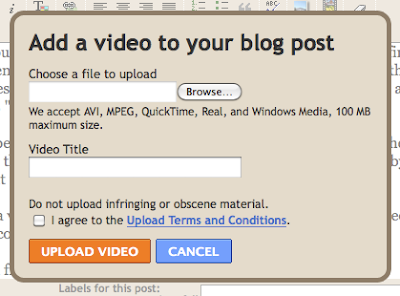
Click "browse" and find the video on your computer. Type in the video title and check the box to the left of "I agree to the Upload Terms and Conditions." When you click "Upload Video," your video will be inserted into your post.
If you'd like to embed a video that is online at a site such as youtube, you can follow the directions here. An embedded video will look like this:
5. THIS IS VERY IMPORTANT! When you are finished with the text and images in your post, you must add 2 labels to your post. One label must be your first name (see the labels listed at the bottom of this post to see the label I've created for your name). The other label should be the assignment (e.g., Research Reflection Week 2, Research Reflection Week 3, etc.). If you are posting but it is not in response to a specific assignment, just label it with your name. This will allow for easy sorting both by person and by assignment.
 You can see where the labels go on the right side underneath the editor. When you have added your labels, click "Publish Post" (big orange button on left under editor).
I hope this helps us get off to a good start.
We moved the blog outside of Sakai based on your feedback. Remember that the main information about your blog post assignments (you can read it here) still apply. The purpose of this post is to highlight some features about this new blog.
- Make sure you are signed in to the blog using the email address that you gave to Leslie. She manually added each of you as authors to the blog. When you go to http://are6746.blogspot.com, click "Sign in" in the top right hand corner. If your email address appears in the top right hand corner, you are already signed in.
- To create a new post, choose "New Post" in the top right hand corner. Give your blog the proper title according to the assignment paper that I linked to above.
- Write your post.
- Embed images and video when necessary: Click on the image icon in the toolbar above
 which will generate a window that looks like this
 If the image you would like to add is on your computer, choose "browse" and find the image on your computer. Then choose "Open." If the image you would like to add is on the web, copy and paste the web address into the box beside "URL." Then choose the orange box at the bottom of the screen that says "upload image."
Your image will appear in your blog post. Often the image will be inserted at the very top of the post. You can move the image wherever you want by clicking and dragging or by cutting the image and pasting it into a new location.
In order to upload a video from your computer to your post, you chose the video icon (just to the right of the image icon), which will generate the following window:

Click "browse" and find the video on your computer. Type in the video title and check the box to the left of "I agree to the Upload Terms and Conditions." When you click "Upload Video," your video will be inserted into your post.
If you'd like to embed a video that is online at a site such as youtube, you can follow the directions here. An embedded video will look like this:
5. THIS IS VERY IMPORTANT! When you are finished with the text and images in your post, you must add 2 labels to your post. One label must be your first name (see the labels listed at the bottom of this post to see the label I've created for your name). The other label should be the assignment (e.g., Research Reflection Week 2, Research Reflection Week 3, etc.). If you are posting but it is not in response to a specific assignment, just label it with your name. This will allow for easy sorting both by person and by assignment.
 You can see where the labels go on the right side underneath the editor. When you have added your labels, click "Publish Post" (big orange button on left under editor).
I hope this helps us get off to a good start.
Subscribe to:
Posts (Atom)